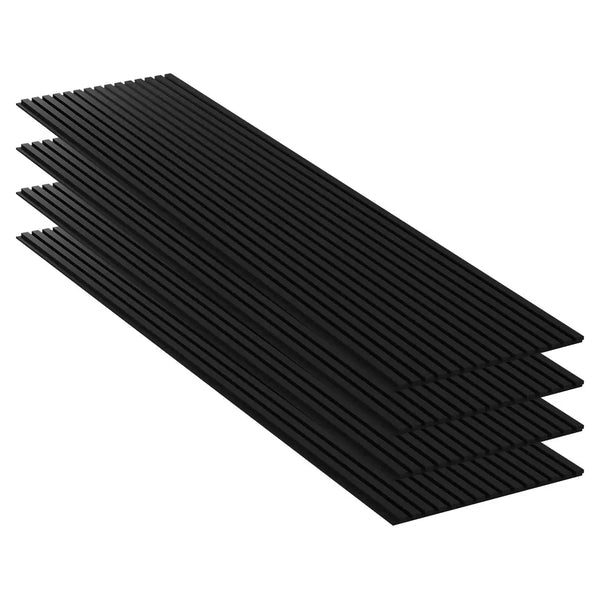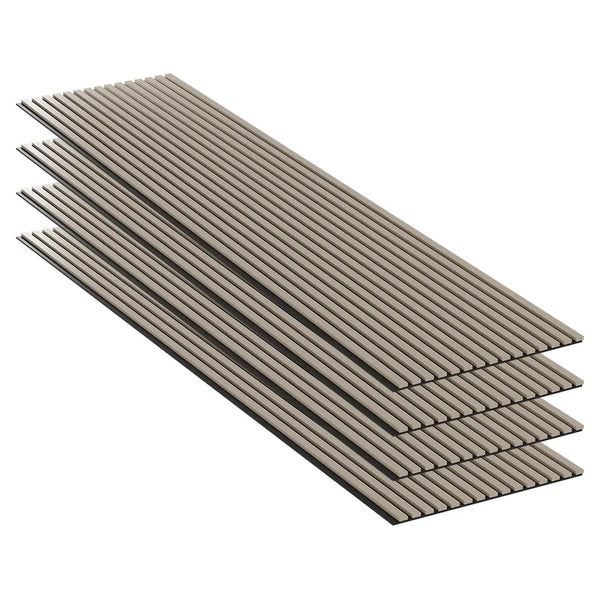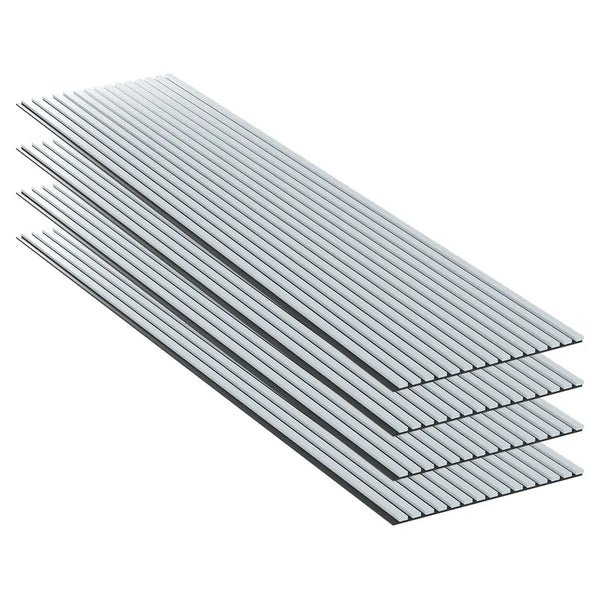
Your living room echoes, the home office becomes tiring on calls, or there's that bare wall behind the sofa you want to dress without choosing the wrong product. In that case, cut through the confusion: an acoustic panel is primarily used to calm room echo, whereas soundproofing deals with noise that passes through a partition. To see the available references, it is best to start from the collection and read each product sheet before discussing installation.
Why wall mounting first requires correctly identifying the need
A wall can pose two very different problems. In a living room, voices can bounce and make the room fatiguing, while a noisy neighbour, the street or equipment call for a completely different soundproofing approach. The right reflex is therefore to name the problem before buying: acoustic comfort inside the room, noise transmitted through the partition, or simple decorative covering.
The French regulatory framework sets requirements for the insulation of buildings and dwellings; those thresholds concern the building as a whole, not a single decorative panel. This is a simple methodological point: a wall panel can improve perceived comfort, but it does not replace a partition designed for insulation.
Starting rule. If the problem is echo, the treatment is about absorption. If the problem is the neighbours, the subject becomes the full partition, its airtightness and its composition.
The right purchase therefore starts with a simple question: what needs correcting, the room's acoustic rendering or the transmission of noise. Once this point is decided, the difference between decorative acoustic panel, flexible adhesive panel and rigid PVC becomes much clearer, and the mounting is chosen without mixing purposes. For a customer looking for wall mounting, this framing avoids the classic mistake: buying an absorbing product believing they are ordering soundproofing.
Acoustic panel, adhesive panel and rigid PVC, three families not to confuse
These types of coverings do not have the same role, nor the same installation method. An absorbing covering can reduce echo and reverberation without preventing sounds from passing through a wall, because absorption acts on reflected energy, not transmitted energy. This is exactly the line to keep in mind when comparing references in a wall collection.
The slatted acoustic panel is primarily for comfort and decoration. It is fixed according to the reference's instructions, by adhesive or by screwing depending on the range, and it serves to calm reflections in the room, not to promise an "insulated" wall. The flexible adhesive panel is read differently: it dresses a compatible substrate and its adhesion depends on the wall, the adhesive and the application time. The marble-effect rigid PVC, meanwhile, is a decorative covering, and any acoustic property must come from an explicit technical data point, not from its appearance.
| Family | Envisaged project | Installation method | First point to check |
|---|---|---|---|
| Acoustic panel | Acoustic comfort and wall dressing | Adhesive or screwing depending on the reference | Product sheet and substrate compatibility |
| Flexible adhesive panel | Quick decoration on a sound substrate | Adhesive specified by the reference | Emission class, substrate and ventilation |
| Rigid PVC | Decorative effect, notably in humid environments if the data sheet allows it | Fixing according to the reference | Intended use, substrate and conditions of use |
The most useful approach remains to separate the visual project from the acoustic project. A background wall behind a sofa, a headboard, a phone booth or a corridor do not require the same response. A decorative panel can change the atmosphere of a room. It should not be sold, nor bought, as regulatory insulation by default.
Prepare the substrate before any installation, the checklist that avoids rework
Installation starts on the wall, not on the panel. A clean and stable substrate avoids rework, and this is even truer for an adhesive or glued installation, where the slightest dust or greasy mark ruins adhesion. Technical prescriptions recommend a surface free of dust, grease and moisture, with substrate preparation before finish coverings.
The seven useful checks before fixing
- Flatness of the wall. The substrate must present a regular surface, otherwise the panel performs poorly and the visual line degrades.
- Real cleanliness. Dust, grease and sticky deposits must be removed before any fixing.
- Absence of moisture. A wall that weeps, seeps or remains cold and damp must first be put back into good condition.
- Adhesion of the render or paint. A flaking layer is not a reliable base.
- Cracks and friable areas. They must be treated before installation, not after.
- Compatibility with the adhesive. The panel's instructions and the adhesive's instructions must be consistent.
- Maintained ventilation. Air must circulate during and after installation to limit the accumulation of pollutants.
Indoor air quality should not be treated lightly. Since 2012, construction and decoration products in France are labelled according to their emissions of certain volatile organic compounds; in practice, check the product's emission class, the adhesive's technical data sheet, the indicated drying time and compatibility with mechanical ventilation or continuous airing.
Do not install on a damp wall, freshly painted and not yet dry, or in an area exposed to heat for flexible adhesive panels. This is a simple mistake, but it costs time and often ends in detachment or deformation. For doubtful cases, it is better to wait until the substrate is sound than to force a "quick" installation.
Screw, glue or stick: step-by-step installation according to the product
Adhesive installation
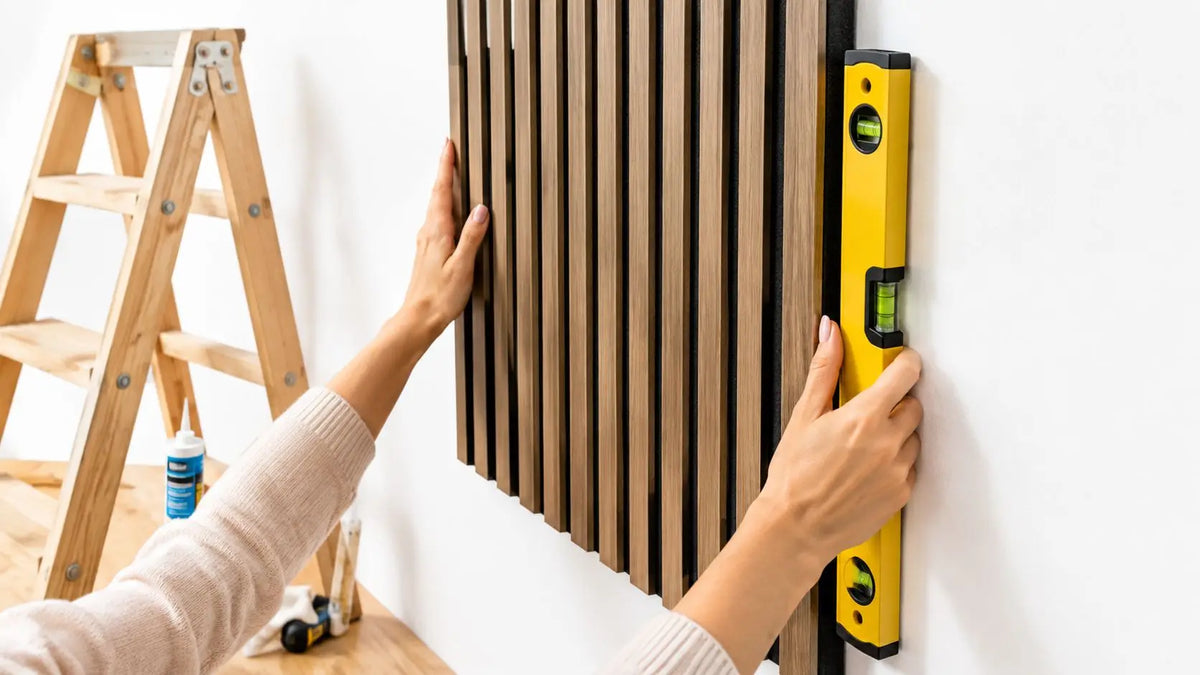
The first rule is to do a dry run. The panel is marked out before touching the wall, especially if the composition must remain regular around a corner, an outlet or a return. Then, the first element is installed from a clear reference point, with homogeneous pressure across the entire surface so that adhesion is uniform.
Setting time matters as much as the gesture. If the adhesive's instructions impose a rest or prolonged pressure, it must be respected; a flexible adhesive panel should not be presented as removable without trace, because removal depends on the wall, the adhesive and the installation conditions.
Installation with glue
The glue is chosen according to the panel's weight, its back and the nature of the wall. A paste adhesive does not serve the same purpose as a bonding sealant, and the consumption per m² belongs to the manufacturer's data sheet, not a general rule. When the panel and the substrate require it, double bonding is specified only in the instructions; it is not decided at random.
The right reflex. The installation sheet and the product sheet always take precedence over generic advice, especially for glue, waiting times and substrate compatibilities.
Installation by screwing
Screwing only makes sense if you reach a load-bearing structure or a truly stable support. When a rail or batten system is used, spacing must be respected and means adapted to the nature of the substrate must be employed. Anchors chosen for the wall avoid soft fixings, pull-outs and unnecessary rework.
For layout, the best result comes from a clean start, with alignment checked from the first panel. The starting height depends on the wall composition and the desired rendering; the logic remains the same: start from a secure line, maintain the same visual spacing between panels and check alignment as you go. For cutting and adjusting formats, an option like the acoustic panels offered by MPDiscount can be installed according to the data sheet of each reference, but the installation logic always remains the same: read the instructions before tackling the wall.
The dimensions 240 × 60 cm, 11 mm and lots of four apply only to the references that list them. The panels of 21 mm are another range, to be treated separately. For fixing details and adhesive logic, the page glue for acoustic panel serves as a practical reference, provided you then return to the data sheet of the chosen reference.
Shortcuts to avoid between absorption and insulation
The most common shortcut is to read an absorbing panel as a global solution. The alpha w, for example, describes the portion of sound energy absorbed by a material in laboratory conditions; that means an absorption performance, not a partition insulation performance. It is incorrect to convert a thickness, a dimension or a number of panels into decibels gained without testing or a declared value for the reference concerned.
What to retain before comparing data sheets
- High alpha w, yes. That means better absorption, not better insulation.
- Thickness alone, no. It is never sufficient to describe complete acoustic performance.
- Decorative panel, yes. If it improves perceived acoustic comfort in the room.
- Insulation between dwellings, no. There you must treat the partition, its weak points and its construction system.
- Complex project, diagnosis useful. As soon as the nuisance persists or involves multiple sources, a prior measurement is more valuable than empirical installation.
Reverberation depends on the room volume and its absorption area, which explains why a small number of panels placed at random often gives limited results. In other words, choose not only the right product but also the right location. A well-placed panel is worth more than an accumulation without logic.
Final checks before clicking to order
Before validating, check five points without improvising. First, is the product meant to absorb echo or to address real insulation. Then, do the product sheet and the installation instructions refer to the same fixing method: adhesive, glue or screwing. Next, is the substrate compatible, sound, dry and stable.
You should also check usage exclusions for flexible adhesive panels, notably humid areas and proximity to heat. Dimensions must be verified by reference, not by habit. Finally, delivery, warranty and return conditions are confirmed on the concerned product page.
For a surface to cover, the calculation method must start from the actual wall, and the page wall surface calculation helps set the correct perimeter before ordering. Professionals can also request a quote and look at quantity discounts from five units, without presuming the exact terms before reading the product sheet.
The right purchase remains simple: a decorative acoustic panel improves perceived comfort in the room, it does not replace insulation designed against transmitted noise.
If you want to proceed without confusing families or mounting methods, MPDiscount offers decorative acoustic panels, marble-effect wall coverings and installation accessories. Visit MPDiscount to compare available references, read the instructions and choose a panel adapted to your wall before ordering.