You have a wall to redo, a weekend ahead of you, and a simple but decisive doubt: will the PVC marble-effect panel really hold on your substrate, or only look good in a photo? The right answer depends less on the pattern than on logistics, especially the chosen format and the real condition of the wall. A large panel does not forgive an approximate substrate, and a small format does not give the same freedom on joints or cutting.
Three decisions before buying a PVC marble-effect panel
A failed job is often decided even before ordering. The first choice is the product family: rigid to glue, thin adhesive panel, or a solution designed for a more technical installation. The second is the format, because a large panel is not handled like a narrow plank, and cutting is not prepared in the same way.
The case of the rushed weekend
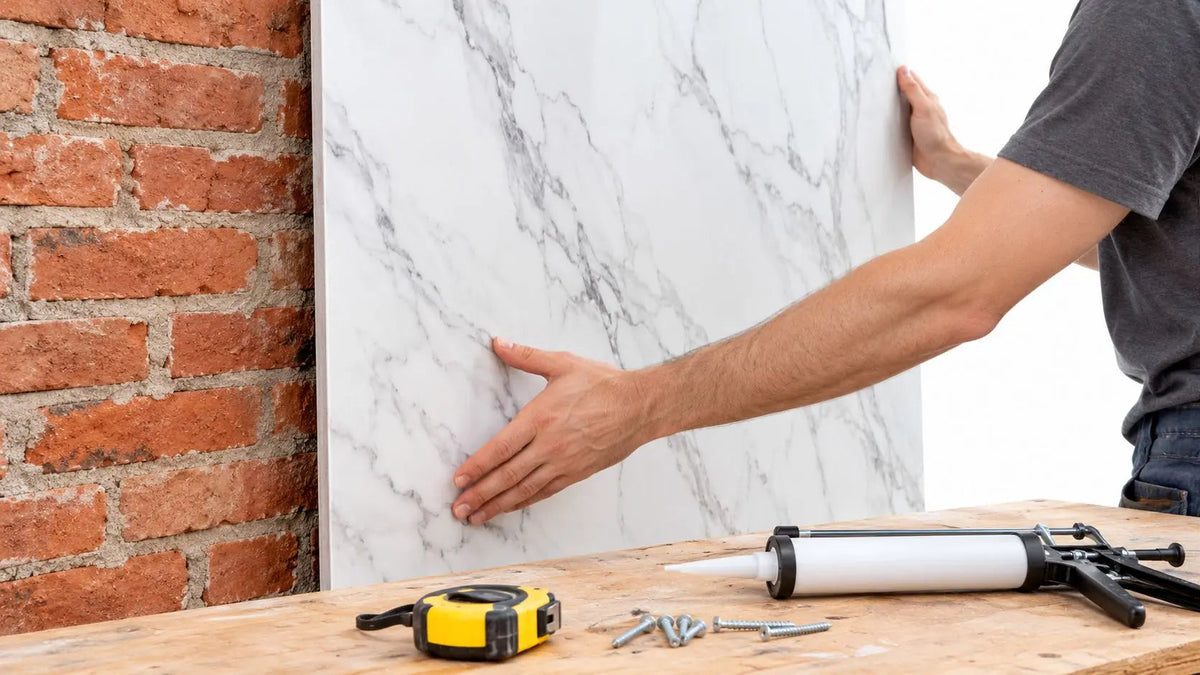
A homeowner who wants to cover a bathroom wall in two days does not buy the same product as an owner who touches up a backsplash or a headboard. Large format reduces visible joins, but it requires more handling space and more anticipation for corner finishes. Conversely, a smaller format is easier to transport, but it multiplies the seam lines and forces greater precision on alignment.
The third choice is the wall itself. A flat, sound, dry substrate accepts a direct installation much more easily than an old, cracked or irregular wall. This is where the panel stops being a simple decoration and becomes a construction decision.
Practical rule. The larger the panel, the cleaner, flatter and more prepared the wall must be before the glue.
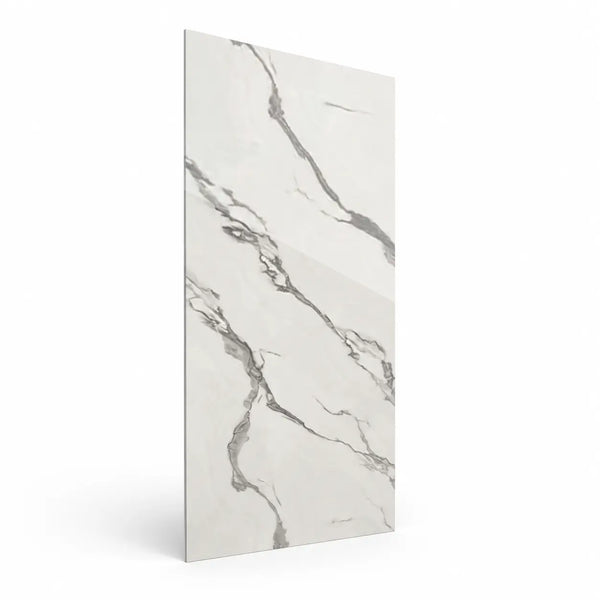
The PVC Panel - Marble Effect Porcelain Stoneware - 250 x 120 cm illustrates this logistical shift well: large format, installation advertised on existing tile, cutting with a cutter and silicone joints. The point to remember is not the marketing talk, it is the practical consequence: this type of panel forces you to think about transport, joins and wall preparation before opening the tube of adhesive.
What a PVC marble-effect panel really is
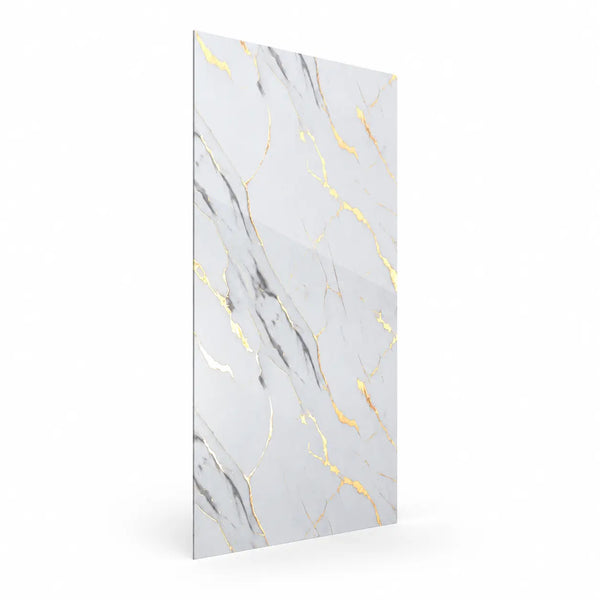
A PVC marble-effect panel is a rigid PVC wall covering, designed to give a marbled appearance without the weight or constraints of a mineral cladding. This type of product fits into a segmented offer, with different uses, finishes and compatible substrates.
Decoration, rigidity and frequent confusion
The word “marble” often creates misunderstanding. Here, it is a printed pattern applied to a rigid panel, not a natural stone. The panel serves to dress a wall with a stable decorative appearance, whereas an acoustic panel primarily targets sound absorption. To decide between materials, consult our comparison of acoustic, self-adhesive and PVC panels.
This difference becomes obvious quickly on site. A rigid panel preserves its visual reading better over long runs, whereas a too-thin covering immediately follows the substrate defects. On a glossy finish, the slightest imperfect wall is even more noticeable.
A decorative panel is judged on two levels: the appearance and the technical compatibility. The substrate and preparation matter as much as the marble effect.
This product is not universal. It replaces well an interior wall cladding, not a stone or a structural solution. The right reflex is to read the exact technical sheet of the panel on MPDiscount, not only the mood photo.
Dimensions, thicknesses and available formats
The format of a PVC marble-effect panel determines the rest of the job. It affects transport, cuts, joints and the amount of preparation to do before the adhesive. A panel designed for a wall of 240 x 60 cm is not handled the same way as a sheet intended to cover a 250 x 120 cm wall.
Before choosing a format, calculate your wall surface with our wall area calculation guide. Without this starting point, you may buy too small, too large, or end up with a difficult layout to correct on site.
Formats that really structure the market
On the French market, you mainly find large decorative panels, often close to 250 x 120 cm or 260 x 90 cm. Several references indicate thicknesses around 3 to 4 mm. The real issue is not the displayed value, it is what it implies for the wall. The larger the panel, the more you must anticipate handling and the precision of cuts.
| Common formats of PVC marble-effect panels | Typical thickness | Recommended use | Logistical constraint |
|---|---|---|---|
| Large panel 250 x 120 cm | around 3–4 mm depending on reference | Entire wall, living room, bedroom, bathroom | Bulky transport, two-person handling |
| Large panel 260 x 90 cm | around 3–4 mm depending on reference | Long wall, vertical cladding | Cutting and alignment must be prepared carefully |
| Compact format | variable depending on reference | Touch-ups, localized areas | Less bulky, but more joints |
The right reading is not to reflexively look for the largest format. A large panel gives a cleaner visual read and reduces visible seams. A compact format simplifies delivery, but it imposes more joints and requires a more rigorous installation to maintain a neat appearance. On a wide, simple wall, large format is often suitable. On a narrow access or a substrate that still requires adjustments, favor installation ease.
Ideal substrate, tolerated substrates and those to avoid
The wall determines the final result more than the marble pattern itself. A PVC marble-effect panel installed on a clean, stable substrate can produce a neat surface. The same panel on an irregular wall reveals itself immediately, especially if the finish is glossy and light grazes the surface.
Where direct installation makes sense
The ideal substrate is simple: flat, sound, dry and load-bearing. A plasterboard lining properly installed, a clean skimmed wall or an old tile that is still well adhered are the most comfortable cases. On these surfaces, direct installation has real logic, because the panel follows the wall instead of having to hide its defects.
Tolerated substrates exist, but they require real reconditioning. An old wall with small irregularities, tired paint or questionable tile should not receive the panel without inspection. You must fill, sand and check adhesion, otherwise the marble decoration accentuates every defect instead of making them disappear.
Warning point. A relief that the eye forgives on a matte paint is immediately visible under a glossy panel.
Where to say no
Walls with deep moisture, overly flexible partitions and unstable substrates should be avoided. Even if the panel itself seems easy to install, the longevity of the fixing depends first on the wall’s behavior. On a substrate that moves, the adhesive works poorly, edges mark, and joints end up signaling problems before the decoration does.
The same logic applies to areas under particular stress. A wall near a heat source or a substrate subject to pronounced temperature variations is not treated like a bedroom partition. You must keep a strict reading of the substrate, not of the desired appearance.
| Substrate compatibility / PVC marble-effect panel | Preparation required | Direct installation possible |
|---|---|---|
| Healthy plasterboard | Dust removal, flatness check | Yes |
| Old tile well glued | Degreasing, check joints and adhesion | Yes, depending on actual condition |
| Clean and stable painted wall | Light sanding if necessary, dry substrate | Yes, if flat |
| Old irregular wall | Filling, sanding, serious check | Not without rework |
| Wall with deep moisture | Treat the problem before any cladding | No |
The right reflex is simple: the wall must be read as a technical substrate, not as a decorative background. If the wall is not ready, the panel will not correct it.
Installation method according to the product
Installation is decided with the product in hand, not by a general DIY rule. A rigid PVC marble-effect panel is not fixed the same way as a thin or self-adhesive version, and the choice of system also depends on the format. On a small panel of 240 × 60 cm, transport and adjustment are easier. On a large surface of 250 × 120 cm, joints, layout and wall preparation immediately become more important.
Adhesive, self-adhesive or screwing
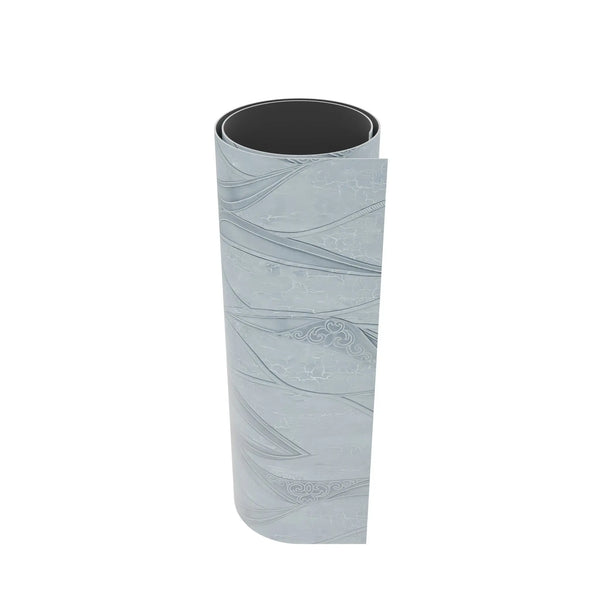
For a rigid panel, glued installation remains the most consistent solution. Versions with integrated adhesive require a perfectly smooth, clean and dry wall, otherwise the grip weakens quickly. Screwing mainly concerns other families of panels, not the common rigid PVC marble decorative panel, except for finishing systems provided by the reference.
The serious method starts with marking the starting line, checking the axis, then applying an adhesive or sealant recommended by the product sheet. On MPDiscount references, the product documentation specifies the recommended installation and the amount of adhesive to plan. Generally count on one to two cartridges of adhesive per panel depending on the format, to be confirmed on the product sheet.
Cutting must remain clean. A cutter is enough for some straight cuts, but technical passages require a more precise tool for sockets and singular points. Joints are treated with flexible silicone, not with an overly rigid sealant that blocks the assembly.
Installation is won at the marking stage, not at the tube of glue. A well-presented panel falls into place; a panel installed too quickly is noticed for a long time.
The real discipline is to respect the product-substrate pair without improvising. If the sheet announces a precise gluing, you must follow that indication. This limits local reworks and edges coming unstuck. On a large format, this rigor matters even more, because a starting defect is hard to correct once the panel is in place.
Which room for which use
The PVC marble-effect panel works when it stays in its place, decorative and wall-mounted. As a backsplash, it can give a neat finish as long as it is not placed in direct contact with a strong heat source. On a bathroom wall, unless the configuration has been checked, it mainly serves to replace old cladding without launching a heavy job.
Uses that make sense
In a bedroom or living room, it plays the role of an accent wall. The marbling reads better with lateral light, because the decoration gains visual depth. On a rental wall, it offers a lighter renovation than a complete substrate replacement, provided you remain modest on preparation and on any eventual removal.
In an interior seeking a more mineral ambiance, a marbled panel can also replace an overly dated covering. The result depends mainly on the format, the number of joints and the precision of cuts. The large panel’s interest comes from this visual continuity, not from an abstract promise.
A good use is not the most ambitious. It is the one where the panel fulfills its role without forcing the wall to be something else.
Bad use is obvious. As soon as real structural resistance, a mineral finish or an exterior logic is required, you must change solution. The PVC marbled panel is not there to replace everything, only to clothe appropriately.
Limits to know before deciding
The worst reflex is to take a marbled panel as a universal solution. It is a compromise: quick to implement and decorative, but it is neither a façade material nor a structural solution. The right purchase starts by checking the exact reference on MPDiscount, not by trusting a general promise.
What to check before believing the sheet
The first thing to look at is the actual thickness. The second is the nature of the decorative surface and the way the panel must be glued. The third is the product compatibility with the intended room, because an interior decorative panel is not read like an exterior covering.
PVC expansion also requires flexibility in the joins. Joints must absorb movement, so assemblies that are too tight over long runs are not a good idea. A decoration that seems continuous on paper may behave less well if the substrate moves or if the layout was too tight.
The healthiest reflex remains comparison with a more mineral solution when durability really matters more than speed. Thin tile or a more adapted technical panel can be more coherent if the project demands long-term hold and more demanding exposure. The PVC marble-effect panel remains a choice for quick, well-thought renovation, not a miracle solution.
Limits are not a defect, they help buy correctly. A well-chosen panel avoids reworks; a poorly chosen panel forces you to start over.
Purchase checklist and rest of the guide
Before validating a cart, the check must remain simple and rigorous. First measure the wall, then add a realistic cutting margin according to corners, outlets and joints. Next, check the flatness of the substrate, because a marbled panel forgives few visual defects.
Points to tick off before payment
- Useful wall dimensions. Measure width, height, and identify necessary cuts around obstacles.
- Substrate condition. Verify it is dry, stable and sufficiently flat for a glued installation.
- Planned installation type. Confirm whether the reference requires silicone adhesive, tile adhesive or another system indicated on the product sheet on MPDiscount.
- Estimated number of cartridges. Plan according to format and consumption indicated on the chosen sheet.
- Exact finish. Check glossy, matte or decorative aspect, because light changes the result a lot.
- Profiles and joints. Check matching finishes if they are necessary for the installation.
- Room-by-room compatibility. Reread the announced use for bathroom, backsplash or decorative wall.
The most useful thing at this stage is to compare references from the MPDiscount decorative wall panel collection. Up-to-date technical sheets allow you to compare format, thickness and installation method without relying on a single photo. When in doubt, MPDiscount customer service can validate the compatibility between the substrate and the dimension before ordering.
The final good reflex is clear: measure the wall, choose three plausible references, then have the format‑substrate pair confirmed before paying. It is the only way to avoid a panel that is too large, too smooth or too ambitious for the actual job.
MPDiscount offers decorative wall panels, including PVC marble-effect references adapted to interior projects where format, substrate and installation method matter as much as appearance. To compare options and start from an up-to-date product sheet, visit MPDiscount and check the exact reference before buying.