A 25 m² living room with 2.50 m ceiling height may require about 7.5 m² of additional absorption to go from a reverberation time of 0.8 to 0.5 seconds (example sizing). Reducing reverberation requires absorbing panels, not an insulation solution, with a surface area matched to the room volume and its reflective surfaces.
The problem often appears after moving in or after light renovation. The floor is hard, windows occupy a large part of a wall, walls remain bare and every conversation seems to linger in the room. The television sounds less clear, voices overlap and a simple hand clap reveals an annoying sound persistence.
The right reflex is to identify the phenomenon before choosing a product. Acoustic panels act on sound reflections inside the living room. They do not, by themselves, block noises transmitted through a wall, ceiling or floor (sound insulation). MPDiscount product sheets indicate dimensions, thicknesses, fixing methods and pack contents; they do not, by themselves, constitute certified acoustic performance evidence.
Identify the acoustic need before buying
In a reverberant living room, sound remains in the room for several moments because it bounces off hard surfaces. The occupant then hears a direct voice followed by many close reflections. The impression is often of less clear speech and greater listening fatigue.
Acoustic absorption acts on those reflections: an absorbing material receives part of the sound energy and limits its return to the room. A wall panel, a rug or a thick curtain can therefore improve listening comfort, provided the treated surface is sufficient.
Sound insulation aims to limit noise transmission between rooms or to the outside and depends on mass, airtightness and wall composition. A decorative panel placed on a wall does not necessarily change insulation.
Practical tip: if the main defect decreases strongly when the living room is filled with furniture, textiles and curtains, the need probably concerns interior acoustic correction (absorption) rather than insulation.
The role of existing surfaces
Glass, tile, concrete and bare walls strongly reflect sounds. An uncovered wood floor can also prolong reflections depending on its construction. An open, sparsely furnished room often combines several of these factors.
Furniture helps but is not always sufficient. A large sofa absorbs and diffuses some sounds, while an irregular bookcase breaks some reflection paths. Conversely, a glass table, a large screen, a picture window or parallel walls can keep acoustics lively despite the presence of furniture.
Understand reverberation and its causes
A conversation produces sounds in many directions. Part reaches the ear directly, another part meets the ceiling, floor, walls or glazing before returning. When these surfaces return a lot of energy, sounds overlap and persist.
Reverberation time measures the time needed for the sound level to decrease after a source stops. In everyday language, it corresponds to the persistence of a hand clap or a syllable. A measurement remains more reliable than a simple impression to set an objective.
Benchmarks and diagnosis
Several public sources give reference values for different types of premises. These values serve as orders of magnitude, but are not mandatory in a private living room. The diagnosis begins with a simple observation: listen from the usual sitting position, produce a short clap and identify zones that return the sound. This method helps decide priority locations for treatment.
What panels actually treat
Absorbing panels reduce the reflections that make speech, television and music less precise. Their effectiveness depends on construction, thickness, position and covered surface. Two isolated panels on a large bare wall can have limited effect even if the material is absorbing.
Low frequencies often present another problem. Subwoofer vibrations, impact noises or rumbles transmitted by a neighbor do not disappear simply with a few soft wall panels. Bass correction requires bulky absorbers and adapted positioning.
Calculate the quantity of panels needed
The calculation must start from the room volume, not from a simple percentage of wall. A tall, sparsely furnished room may require more absorbing material than a room of the same floor area already furnished with textiles and furniture.
Sabine’s formula links volume, reverberation time and equivalent absorption area; it serves as an estimate if the actual performances of the panels are known and if the absorption already provided by furniture is taken into account.
A four-step method
- Measure the volume. Floor area × ceiling height. For 25 m² × 2.50 m = 62.5 m³.
- Describe the initial state. Note floor, glazing, bare walls, ceiling, rugs, curtains and furniture.
- Choose a reasonable objective. Technical example: aiming for a shorter reverberation time (for example 0.5 s) can lead to adding about 7.5 m² of equivalent absorption in the cited example, subject to the actual performance of the panels and existing furniture.
- Convert the area into number of panels. Multiply the useful surface of one panel by the number of units. Consult the product sheet for the effective surface, thickness and mounting method.
The result of 7.5 m² is an example sizing and not a universal order quantity. A living room already equipped with a large rug and curtains will require fewer panels; a room open to a kitchen may require more treated surface.
Where to place the absorbing surface
Treat first reflections as a priority: side walls around the listening position, wall behind the screen or main source. Preparing a sketch with windows, doors, sofa and screen helps target locations. Progressive installation allows listening to the evolution before adding more surface.
The MPDiscount wall surface calculation guide (mpdiscount.com/blogs/conseils/calcul-surface-mur) can help with support geometry; it does not replace an acoustic estimate based on volume and already present absorbing surfaces.
Choose the right type of panel
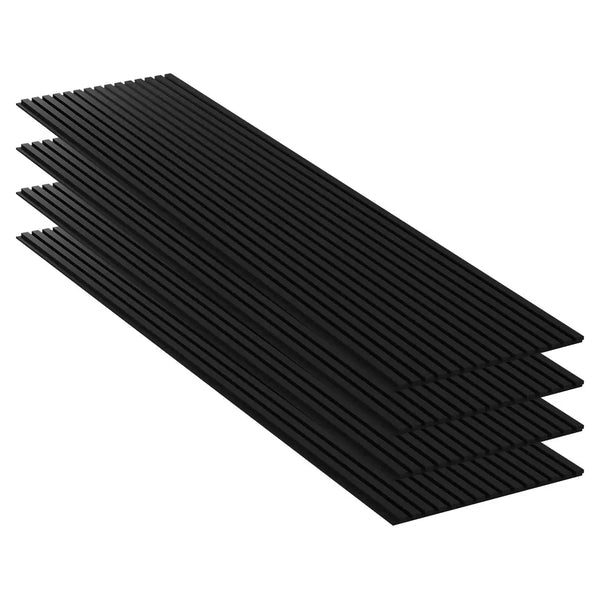
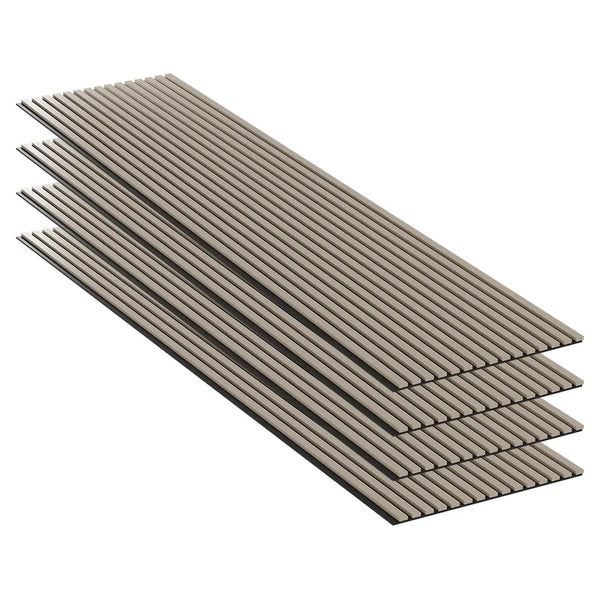
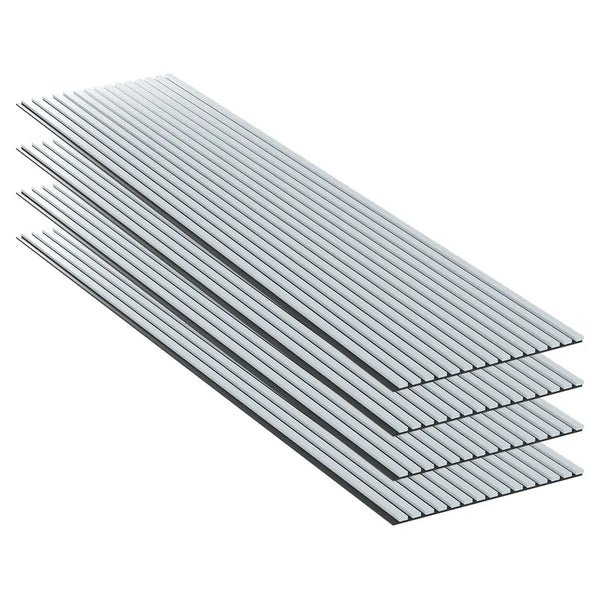
The choice must follow the project priority: listening comfort (absorption) or simple decorative cladding. Slatted panels combine decorative finish and felt backing; adhesive soft panels allow quick installation but have limits related to the support and adhesive durability. Rigid PVC with marble effect is mainly decorative and will reflect sound more than materials designed to absorb reverberation.
Dimensions, thickness and mounting must be checked on the product sheet. For example, some MPDiscount references exist in 240 × 60 cm, in 11 mm or 21 mm thickness, and are offered in packs (exact characteristics appear on each product sheet).
Adhesive soft panels
Suitable for smooth, clean surfaces, without drilling. Limits: removal may leave marks, incompatibility with wet areas or heat sources, and limited effectiveness if sizing is insufficient.
Rigid PVC and slatted panels
Rigid PVC favors decorative appearance and robustness; it is not the acoustic equivalent of an absorbing panel. Slatted panels provide structured cladding and require precise marking around sockets and skirtings. The product sheet indicates fixing method, thickness and installation precautions.
Install panels for optimal effect
Prepare the wall: clean, dry, dust-free and flat. Preliminary marking, dry-fit the elements and check alignment. The fixing method depends on the reference: adhesive, compatible glue or screwing according to weight and rigidity.
Prepare the substrate
Remove dust and grease, stabilize fresh paint, repair friable parts. For adhesive installation, remove the protective film progressively and press from the center to the edges to limit bubbles. An irregular surface prevents good contact and reduces the mechanical effectiveness of the fixing.
Adapt the fixing to the product
Use an adhesive recommended by the product sheet. Screwing requires locating studs and services and choosing suitable plugs. A regular installation facilitates any later extension of the treatment.
Checks before purchase and installation
Compare the acoustic need, available surface and the exact characteristics of the reference. Commercial images are not sufficient to determine thickness, weight, fixing or actual coverage.
Checklist
- Acoustic objective. Confirm the project aims to reduce echo and reverberation and not insulation between dwellings.
- Room volume. Take floor area and ceiling height.
- Reflective surfaces. Note glazing, hard floor, bare walls and ceiling.
- Existing furniture. Account for rugs, curtains, sofas and bookcases.
- Actual dimensions. Verify whether the reference is 240 × 60 cm, 11 mm or 21 mm, and the pack content (pack of 2 or pack of 4).
- Wall support. Confirm compatibility with paint, plaster, masonry or wood.
- Mounting method. Adhesive, glue or screws according to the product sheet.
- Environment. Exclude adhesive panels from showers, wet areas and heat sources.
- Removal. Do not promise removal without trace for an adhesive fix unless otherwise stated on the product sheet.
- Cutting. Plan for corners, sockets, switches and skirtings.
Warranty, stock, delivery, return and weight information must be checked on the corresponding MPDiscount product sheet. They cannot be inferred from a photo or a general description.
MPDiscount products cited (check the product sheet before ordering)
- Acoustic Panels Oak – 240×60 – 21 mm – Pack of 2
- Acoustic Panels Rose – 240×60 – 21 mm – Pack of 2
- Acoustic Panels Dark Walnut – 240×60 – 21 mm – Pack of 2
- Acoustic Panels Walnut – 240×60 – 21 mm – Pack of 2
- Acoustic Panels Leather Gray – 240×60 – 21 mm – Pack of 2
- Acoustic Panels Matte Black – 240×60 – 21 mm – Pack of 2
- Acoustic Panels Light Oak – 240×60 – 21 mm – Pack of 2
- Acoustic Panels Light Oak – 240×60 – 11 mm – Pack of 4
For measurements, classifications or official documents (regulations, reference reverberation times), request the documents from the competent organizations or consult the manufacturers’ technical data sheets and notices. Do not assume standards or acoustic performances without documents provided by the manufacturer or an accredited laboratory.
Conclusion and realistic expectations
A comfortable living room depends on a prior assessment: distinguish absorption and insulation, estimate the volume, identify reflective surfaces and the absorption already provided by furniture. The example of the 25 m² living room illustrates the use of a calculation based on equivalent absorption area; the surface to add is then distributed on first reflections and around the listening position.
Acoustic panels improve interior comfort, but do not make a living room soundproof with respect to neighbors or the outside. Material choice matters as much as quantity. Consult MPDiscount product sheets to verify dimensions, thicknesses, fixing methods and pack contents before ordering.