A wall reverberates, voices blend and the television sounds harsher than it should. The choice seems simple until you have to decide between a bookshelf, a dark paint and a black acoustic panel. The finish must integrate with the decor, but effectiveness depends mainly on the material, thickness and installation.
A matte black panel can structure a wall, frame a television area or give depth to an office. However it does not correct all sound problems. Before purchasing, you must therefore distinguish absorption from echo, sound insulation, the panel type and the mounting method.
Why choose a black acoustic panel
A customer who wants to dress the wall behind a television often hesitates between several solutions. A dark paint creates an atmosphere, a bookshelf diffuses reflections thanks to its volumes, while a matte black panel combines graphic presence and treatment of some reflected sounds. The choice becomes relevant when the wall is both visually too bare and too reverberant.
Matte black provides a visual anchor point. Its contours remain sharp, its reliefs stand out under side lighting and its surface limits glossy reflections. On a white wall, it forms a strong contrast behind a screen or a sofa. On a dark wall, it blends more with the whole and highlights the furniture lines.
A finish suited to several rooms
The black acoustic panel naturally fits in:
- A home studio or a game room, where the relief accompanies an immersive atmosphere.
- An open-plan office, where an absorbing surface can make exchanges more comfortable.
- A restaurant or a professional space, where the wall must remain decorative without appearing overloaded.
- A living room with a wall-mounted television, where the black structures the listening area and reduces the bare-wall effect.
- A home cinema, where a dark finish matches a low-light atmosphere.
Color does not create any additional acoustic performance. A black panel mounted directly on a wall does not become more absorbent than a light model made with the same structure. The result depends on the backing, thickness, any air gap behind the panel and the data indicated on the product sheet.
Practical rule: choose the color with your eyes, verify performance with the technical sheet and the planned installation.
Absorption, insulation and echoes: what are we really talking about
In a very reverberant room, voices linger and sounds blend. A acoustic panel absorbs part of the waves present in the room, limits their rebounds on hard surfaces and improves listening comfort. Sound insulation addresses another problem: it aims to reduce the transmission of sound through a partition, a floor or a ceiling.
Tile, glazing and smooth ceilings send voices back in several directions. An absorbing covering attenuates part of these reflections, but it does not block music that travels through a light partition.
Decorative black panels generally fall under interior acoustic correction. According to the product sheet, they may include a felt, PET, polyester fibers or a mineral underlayer. Structure, thickness and mounting determine the amount of sound absorbed. The matte black finish therefore does not create an acoustic gain by itself. A rigid, smooth cladding mainly reflects waves.
What the panel actually corrects
The treatment mainly acts on:
- Perceptible echo, especially in a sparsely furnished room.
- Reverberation, common with tile, glazing and smooth walls.
- Parasitic reflections, which muddle conversations or recordings.
- Listening fatigue, when several sources overlap in an office or family room.
In a home studio, place panels around first reflection points, behind speakers or on the ceiling, depending on the layout. In a living room, office or television room, look mainly for more comfortable listening and clearer voices. A panel does not replace a full acoustic study in a demanding room.
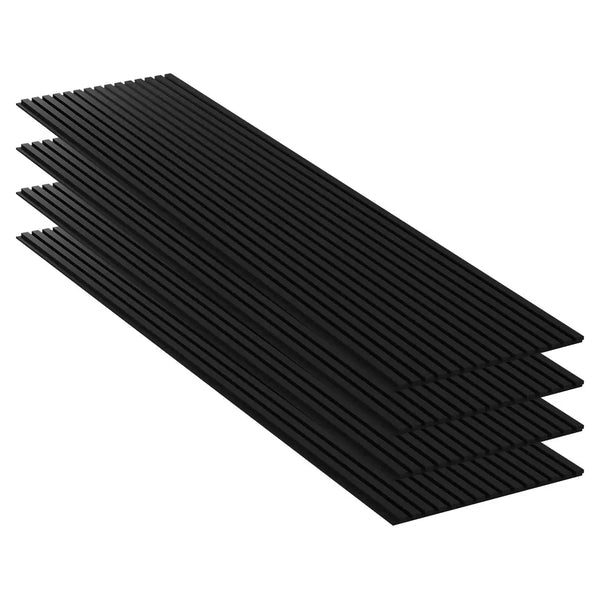
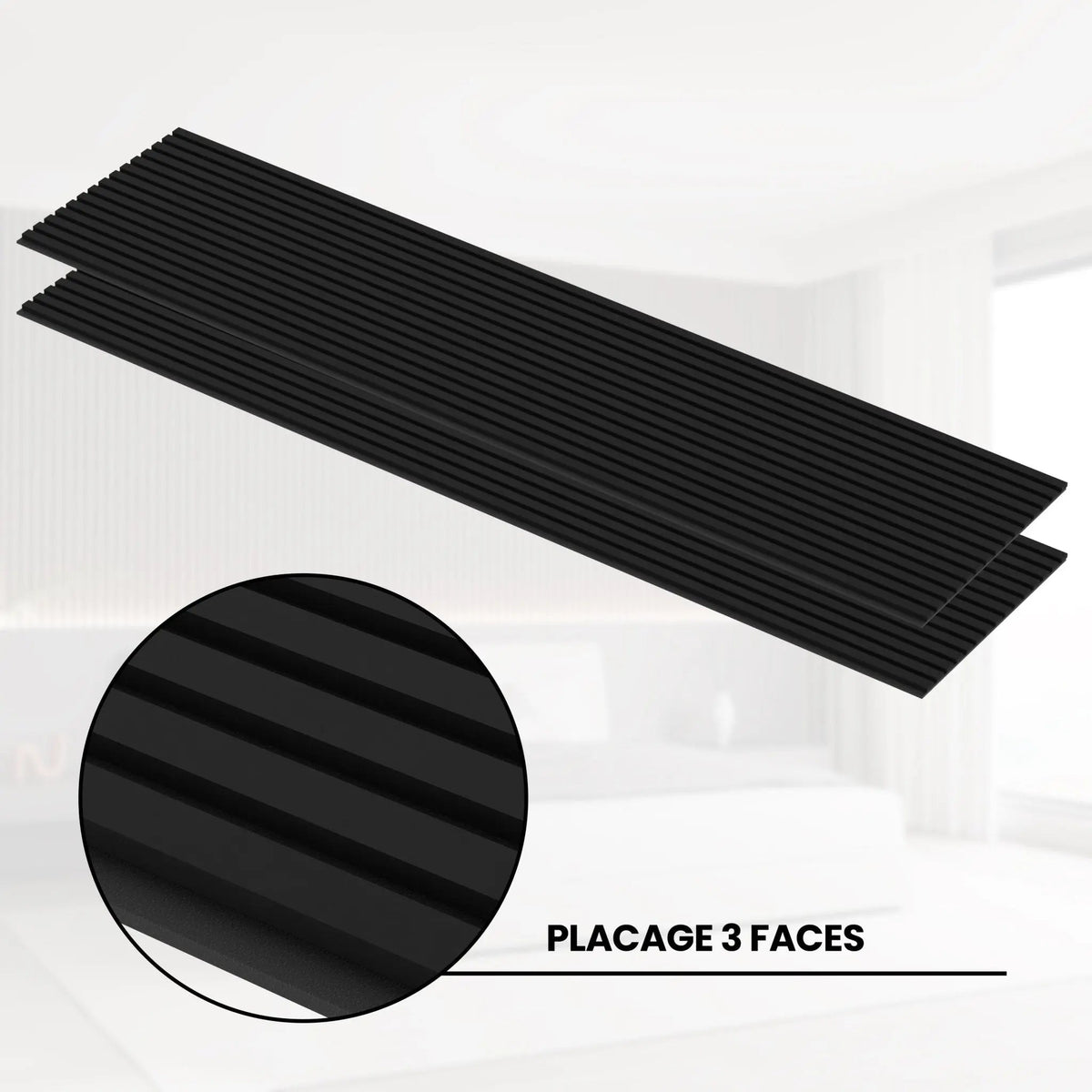
The MPDiscount guide on reducing noise with acoustic panels distinguishes room treatment from sound transmission. For a product reference example, the Black Matte Acoustic Panels, 240x60, 21 mm, pack of 2 combine recycled acoustic felt with MDF slats veneered in matte black. The sheet indicates direct mounting on the wall or ceiling, with silicone adhesive or screwing. Always check the sheet of the chosen model.
Important note: commercial statements on some product sheets (e.g. “acoustic correction”, “superior sound absorption”, etc.) describe the intended use and do not replace test measurements. If you need measured data (absorption coefficients, test configurations, fire rating, test reports), request the technical sheet or the test report corresponding to the product and the mounting configuration; these documents allow evaluating real performance in the intended conditions.
Read performance without being tricked
To compare absorption, ask for test data corresponding to the reference and the envisaged mounting. Black color and total thickness are not sufficient to deduce acoustic performance.
Acoustic panel, adhesive panel or rigid PVC
The three families sometimes look similar in a photo, but they do not meet the same needs. The acoustic panel is chosen to absorb part of the sound. The adhesive panel mainly serves to quickly change a surface’s appearance. Rigid black PVC is more suitable for a durable wall cladding than for acoustic correction.
| Family | Dominant material | Main use | Common mounting method | Limit to know |
|---|---|---|---|---|
| Acoustic panel | Felt, PET, fibers, foam or structure with absorbing backing | Reduce echo and reverberation | Adhesive, screws or mounting with rear gap according to the sheet | Performance strongly depends on thickness and mounting |
| Adhesive panel | Thin vinyl, textile or lightweight covering | Quickly change a wall's appearance | Integrated adhesive or double-sided tape | Low thickness does not necessarily provide real acoustic absorption |
| Rigid black PVC | Compact or cellular PVC | Clad, protect or renovate a surface | Adhesive, suitable glue or screwing | Rigid material mainly reflects sound |
The right choice according to the need
For a resonant living room, the acoustic panel family is the one to examine first. The sheet must specify the type of fiber or foam, density, thickness and, if available, measured absorption in an identified configuration.
For a quick visual transformation, an adhesive panel may be suitable. However avoid presenting it as an acoustic treatment without manufacturer data. A thin vinyl can cover a wall, but do not attribute low-frequency absorption to it without technical proof.
Rigid PVC follows another logic. It resists certain usage constraints better and can be suitable for a black wall cladding, but its rigidity places it on the reflective surfaces side. It does not become an absorbing panel because it is sold in a section dedicated to wall decoration.
Indices to check on the product sheet
Before ordering, look for:
- The dominant material, felt, PET, foam, fiber or PVC.
- The real thickness, not just the decorative relief thickness.
- The density per square meter, when provided.
- Fire rating, if required for a professional establishment.
- The finish, matte black, satin black or glossy black.
- The fastening method, adhesive, glue or screws.
- The tested configuration, wall-mounted, suspended, with battens or with insulation.
This reading avoids confusing a black decor with a product designed to correct reverberation.
What the matte black finish changes
In a room lit by side spots, a matte black finish attracts fewer direct reflections than a glossy surface. It gives the slats a denser look and reinforces the wall’s presence. With pronounced relief, edges stand out thanks to the contrast between lit areas and shadows.
This finish requires precise installation. On a dark ensemble, an irregular wall, a visible joint or a poor alignment become noticeable quickly, especially under grazing light. Matte black therefore does not hide defects. LEDs or side-mounted spots can even accentuate them.
Relief, thickness and shadow play
A thin, smooth panel creates a sober look. A slatted model or one with deep relief produces a sharper alternation between lit surfaces and dark parts. The matte black model presented by MPDiscount displays a thickness of 2.1 cm, with MDF slats veneered in matte black over a recycled acoustic felt. Always check these characteristics on the product sheet before finalizing your choice.
The depth effect remains visual. It is not sufficient to determine the acoustic result. Relief can modify the reflection of part of the sound, while absorption depends on the entire structure and how the panel is installed. An air gap left behind the panel can therefore produce a different behavior than a directly glued installation.
The sheet for the black matte acoustic panel in 240x60 and 21 mm indicates installation on the wall or ceiling, with silicone adhesive or by screwing. It also recommends a circular saw for cutting. Check the planned configuration on the product sheet rather than choosing solely by color.
Maintenance becomes more visible
Dust is noticed quickly on matte black, notably in grooves and on the felt. This is a visual effect of the shade, not a material defect. This look suits a cinema atmosphere, a dark office or a wall behind a screen, if you accept regular dusting. Use the maintenance gestures indicated on the product sheet to preserve the finish.
How to install a black acoustic panel
Fastening is chosen according to weight, substrate and location. A light panel can receive an appropriate adhesive. A thick or heavy panel requires a compatible glue or screwing, especially on the ceiling and on a frame. The product sheet remains the reference to confirm each configuration.
Prepare the substrate
The wall must be clean, dry and sufficiently flat. Powdery paint, poorly glued wallpaper, a damp area or a friable surface compromise adhesion. Before drilling, always check for utilities with a detector. A panel of 12 kg installed on the ceiling requires anchors suited to the substrate, not just to its mass.
The matte black model presented by MPDiscount measures 240 x 60 cm, weighs 12 kg per panel and covers 1.44 m² per panel. These data must be compared with the substrate resistance and the chosen fastening system. Always check the characteristics of the exact product before starting.
Choose the fastening
- Neutral silicone adhesive, for a durable bond on a sound substrate. Check its compatibility with felt, MDF and the wall covering.
- Double-sided adhesive, for a light installation when the product sheet allows it. Degrease the surface and avoid loading the edges.
- Through screwing, for thick panels, ceilings or irregular supports. Screws, anchors and attachment points must match the actual weight and the nature of the substrate.
Fastenings and complementary products are grouped in the MPDiscount installation accessories collection. Confirm compatibility with each covering before purchase.
Proceed neatly
Measure the area, mark a starting line and check plumb. Fit the panel dry, let it acclimatize in the room, then cut it with the appropriate tool. For the matte black model concerned, the sheet recommends a circular saw.
Apply the adhesive, position the panel and hold it during the manufacturer’s recommended curing time. Temporary shoring limits slipping. Check the level before placing the next panel, because a small error repeats quickly across a series of slats.
Avoid these mistakes:
- Solvent-based glue on foam, which can attack it.
- Bonding on wallpaper, whose adhesion is not guaranteed.
- Installing in an unventilated damp room, which can promote mold.
- Drilling without locating utilities, which exposes unnecessary risk.
- Undersized fastening, especially on ceilings or with a heavy panel.
Maintenance and simple daily actions
Matte black mainly requires regularity and gentle gestures. Dust shows more on a dark surface, particularly in the grooves of a slatted panel or on a black felt. Aggressive cleaning risks dulling the finish and damaging the textile or foam.
Dust without marking the surface
For light soiling, a dry microfiber is generally sufficient. On a pronounced relief, low-power vacuuming with a soft brush allows reaching grooves without pulling on the felt.
The matte black model presented in the catalog indicates maintenance with a vacuum cleaner fitted with a soft nozzle or with a dust broom. The movement should remain slow, without excessive pressure on the slats or repeated rubbing in the same spot.
Clean a localized mark
A mark is treated with a well-wrung damp cloth. The cloth must not soak the felt or leave water in the joints. After wiping, the area should dry naturally in a properly ventilated room.
Abrasive products, solvents, bleach and aggressive sprays are to be avoided. They can alter the matte shade, mark the slats or degrade fibers. The exact product sheet remains primary, because a PET panel, a textile panel and painted foam do not necessarily accept the same products.
To remember: on matte black, the softest cloth is often more useful than a powerful cleaner.
An eventual touch-up must use a solution compatible with the covering and, if possible, a shade recommended by the manufacturer. The same principle applies to maintenance products. Compatibility with the material must be checked before application, even if the mark seems minor.
Pre-purchase checklist and useful resources
Before choosing a black acoustic panel, five checks avoid most mistakes. They ensure the product addresses the sound problem and can be installed properly in the intended room.
The five essential checks
- Measure the surface to cover. Width, height, angles, sockets and switches determine the number of panels and the cuts required. Also check the useful dimensions indicated on the sheet, because the advertised area may correspond to a panel, to a pack or to a specific width.
- Identify the sound nuisance. A voice that reverberates, a room that remains harsh after installing a television and conversations hard to follow indicate a reverberation problem. A sound that travels through a partition to another room concerns insulation, which a decorative panel does not treat alone.
- Examine the wall substrate. The wall must be sound enough to receive glue, adhesive or screws. A damp, friable surface or one covered with poorly fixed covering requires preparation before installation.
- Validate the fastening method. Weight, location and thickness guide the choice. A panel intended for glued mounting is not automatically treated like a model designed for a frame or screwing.
- Confirm the matte black appearance. A sample or a visualization in the room allows observing the shade under natural light, LEDs and grazing lights. Black can blend into a dark wall or become a strong contrast on a light paint.
Sheets to consult
MPDiscount collections bring together decorative acoustic panels in several finishes and thicknesses, as well as wall panels, mirrors and installation accessories. The characteristics of each reference must be consulted before ordering, notably material, dimensions, fastening, maintenance and applicable conditions.
The matte black model with MDF veneered slats and recycled acoustic felt is an option to consider for a home cinema, a studio, a loft or an office. Its sheet indicates direct mounting on the wall or ceiling, with silicone adhesive or by screwing. It also specifies dimensions, weight, recommended cutting and maintenance gestures.
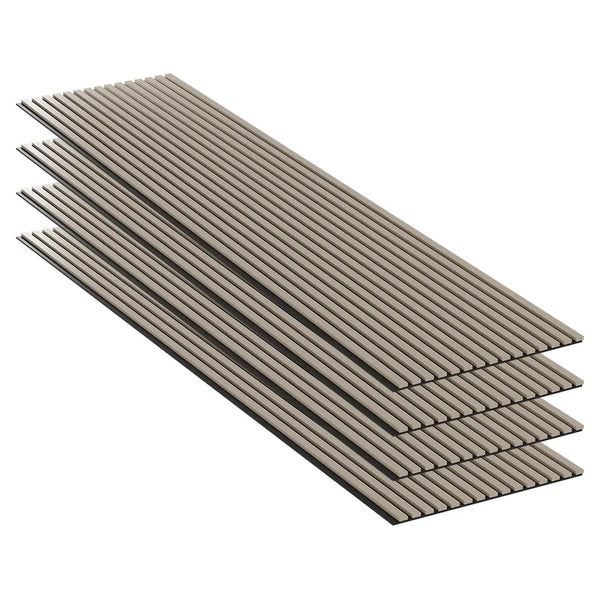
For a less uniform contrast, the reference Oak Acoustic Panels, 240×60, 21 mm, pack of 2 combines MDF slats veneered in oak with a recycled black acoustic felt. This finish suits a decor where the black backing must remain present without visually covering the entire wall.
Decide without making a mistake
The right purchase is not the darkest panel nor the one with the most spectacular relief. It is the one whose composition, installation and maintenance match the room. A reliable sheet should make it possible to understand what absorbs, what decorates and what holds the panel in place.
MPDiscount offers decorative black acoustic panels, finish variants and installation accessories for residential and professional projects. To verify dimensions, material, fastening and applicable conditions before purchase, the reader can consult MPDiscount and select the sheet corresponding to their room.