A freshly furnished room can look stylish, but become tiring as soon as a conversation starts. Voices overlap, footsteps bounce off the walls and every call leaves an impression of din. Before buying an absorbing acoustic panel, however, you must identify the exact problem, because reducing echo in a room and blocking noise coming from a neighbor are not solved by the same solution.
The right choice then depends on the room’s use, its existing surfaces, the furniture, the wall substrate and the desired aesthetic. A panel can noticeably improve acoustic comfort without turning a lightweight partition into a soundproof barrier. This distinction prevents buying a product suited to acoustic correction when the real need is insulation.
Acoustic absorption and sound insulation
An absorbing acoustic panel does not automatically block neighbor noise. It mainly acts inside the room by limiting sound reflections on the walls, ceiling and other hard surfaces. Speech becomes more intelligible, echo decreases and the sense of resonance recedes, but noise transmitted through a partition, a floor, a door or a window remains a different problem.
This nuance is important: correcting the room’s sound ambiance (absorption) and insulating between two spaces (sound insulation) follow different principles. A panel mounted on a wall can absorb part of the energy reflected in the room. It does not, by itself, create a heavy, airtight and decoupled partition.
The right diagnosis before buying
The most useful test is to listen to the room when it is empty or sparsely furnished. If a voice continues to “float” after the sentence ends, if a table strongly resonates or if several people struggle to understand each other, the need probably concerns acoustic correction. Very mineral living rooms, open-plan offices, halls, restaurants and rooms with lots of glass or smooth surfaces are often affected.
Conversely, a nuisance coming from the neighboring dwelling, the stairwell or the street calls for thinking about transmission paths. It may involve the partition, the ceiling, the floor, the joinery or air gaps. Adding a decorative panel to the visible face of the wall does not necessarily address these weak points.
Practical rule: if the disturbing sound mainly comes from outside the room, an absorbing panel is not the first response to consider.
French regulation separates acoustic correction issues from building acoustics. For new constructions, obligations exist on certain points (common circulation, etc.) and the official documents of the Ministry for the Ecological Transition address building acoustics. These texts show the interest of treating reflections in a space, not promising universal insulation.
When the panel is relevant
The absorbing acoustic panel is particularly appropriate when the objective is to:
- Reduce echo, in a sparsely furnished living room or a reverberant workroom.
- Improve intelligibility, in a meeting room or a conversation space.
- Reduce din, in an open-plan office or a place hosting several people.
- Structure a wall, when the treatment must also contribute to interior design.
Complete sound insulation may require a heavier design, with appropriate materials, careful airtightness and sometimes decoupling of elements. The absorbing panel then remains a possible complement, not a replacement for the system.
How absorbing panels work and their materials
Sound behaves like energy that reflects on hard surfaces. A painted wall, glazing or a mineral floor returns a large part of this energy to the room. When multiple reflections intersect, the ear perceives prolonged echo or a confused ambiance.
An absorbing material works differently. Its structure lets part of the air movements caused by the sound wave penetrate. In a porous or fibrous material, these movements encounter resistance and part of the sound energy dissipates. The simplest analogy is to compare a ball bouncing on a hard floor with a ball sinking into a soft surface. The sound is not eliminated, but its return to the room is reduced.
The materials that actually absorb
Open-cell foams, felts, protected mineral fibers and certain acoustic textiles can help absorb reflections. Their effectiveness does not depend solely on appearance. Thickness, internal structure, installed surface, mounting and the possible presence of an air gap behind the panel influence the result.
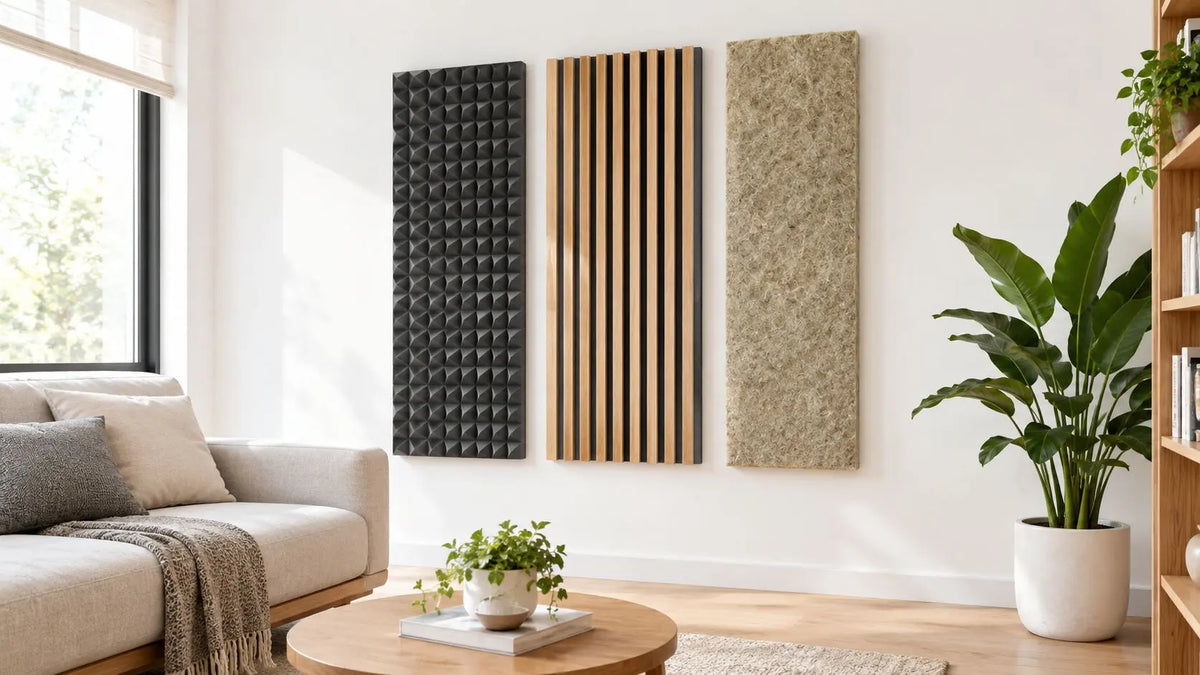
A cellular or pyramid foam can suit targeted correction, especially when a light, cuttable installation is sought. Its shape, however, does not guarantee better performance than a flat panel. Two products with different relief should be compared based on their technical characteristics and actual mounting, not solely on appearance.
Mineral wool can offer an extended absorption potential, provided it is integrated into a protected system adapted to the room. Acoustic felt brings a decorative finish and can be cut to suit the layout. In each case, the product datasheet remains decisive, since two materials from the same family can behave differently.
Why wood slats work
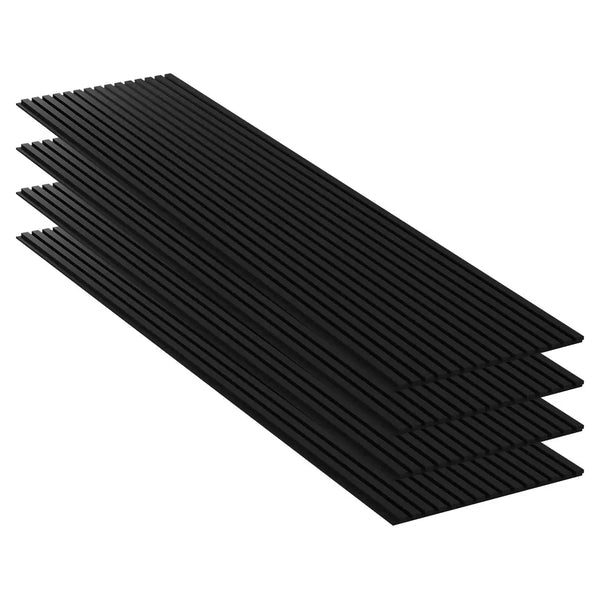
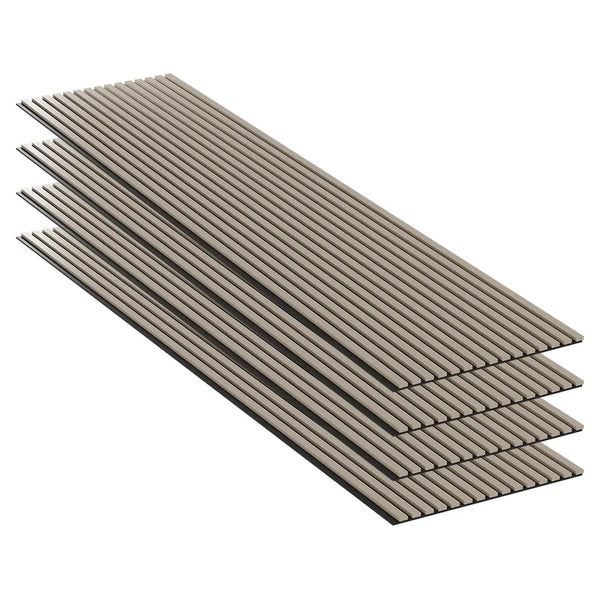
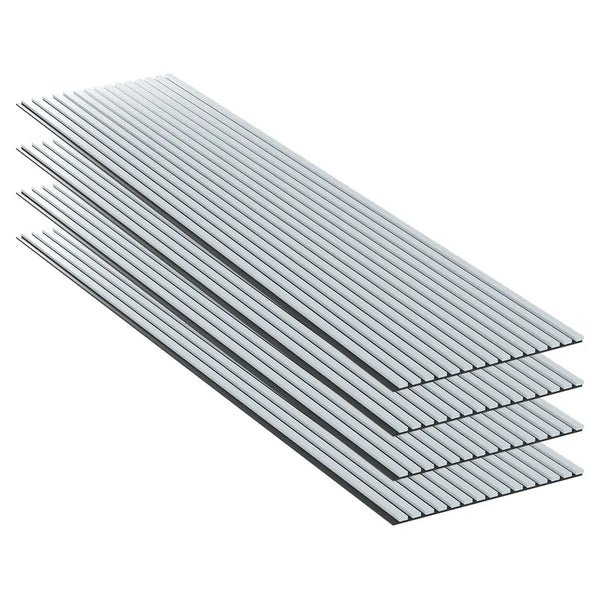
Decorative slatted panels generally combine a perforated wooden surface with a felt backing. The slats do not form a completely closed sheet. The spaces between them let part of the acoustic energy reach the absorbing backing placed behind. The wood contributes to the aesthetic and to diffusion of reflections, while the felt helps limit their direct return.
This assembly allows integrating a sound treatment into a residential or professional interior without giving the appearance of a technical device. A light finish on dark felt creates an architectural contrast; a colored finish can become an accent wall. Acoustic performance and decorative choice must, however, remain linked to the actually treated surface.
The absorbing backing does not transform the panel into a sound insulation solution. It treats the ambiance inside the room, whereas a separating partition requires a logic of mass, airtightness and decoupling. This distinction also applies to rigid PVC, which is primarily a decorative or protective wall covering. A smooth, closed rigid PVC surface should not be equated with an acoustic absorber simply because it covers a wall.
Measuring performance and sizing your project
In a resonant room, adding panels at random is not enough. You must first distinguish acoustic correction, which reduces reflections inside the room, from sound insulation, which limits noise transmission through a partition. The sizing here concerns the room’s ambiance, not the wall’s capacity to block neighboring conversations.
An often-cited indicator is the absorption coefficient (alpha), expressing the share of energy absorbed by a material under measurement conditions. Standardized protocols exist to measure this coefficient. Products may reference these values on their technical datasheets: always check the datasheet of the chosen reference to know the measurement conditions, the thickness and the mounting associated with the displayed figure. Do not turn an isolated value into a promised result without taking into account volume, positioning and the treated surface.
Some practical benchmarks are used by professionals to estimate a room’s needs (for example targets for reverberation time according to use). These benchmarks vary by source and use; they serve as guidance, not as guarantees. For a reliable comparison between products, use the indications provided in the technical datasheets and request test protocols if necessary.
Indicators to read
| Indicator | Definition | Common objective |
|---|---|---|
| Absorption coefficient | Share of the sound energy absorbed by the material under the measurement conditions | Compare the absorbing potential of a panel (see product datasheet) |
| Absorption class | Category derived from a standardized method | Position the overall performance of a solution (if the datasheet indicates it) |
| Reverberation time | Duration during which the sound remains perceptible after the source stops | Reduce echo and improve intelligibility |
| Absorbing surface | Amount of panels actually installed in the room | Adapt the treatment to the volume and use |
A realistic sizing method
The number of panels must start from actual use, not from a universal marketing rule. A furnished living room, an open space and a restaurant room have different volumes, reflective surfaces and occupancy levels.
Take the following in order:
- Volume and ceiling height, because a large empty room retains more sound energy than an already furnished space.
- Hard surfaces, notably glazing, tile, bare walls and ceiling.
- Existing furniture, which already absorbs or diffuses part of the sound.
- Main use, conversation, videoconference, reception, dining or collective work.
- Treatment distribution, placing panels across several zones rather than concentrating them arbitrarily on a single wall.
Some commercial benchmarks mention percentages of treated surface depending on the room type. These benchmarks do not apply uniformly to all configurations. Height, furniture, geometry and use should guide the decision. The MPDiscount guide dedicated to calculating wall surface helps take measurements before ordering and avoid an estimate based only on floor area. Also consult the MPDiscount product datasheet of the chosen reference to know its exact characteristics.
Choose the right panel according to the room and style
The panel suited to a living room is not necessarily the one for an open-plan office. In a dwelling, the issue is often reducing an annoying resonance without changing the decor. In a professional space, the priority can be understanding exchanges, controlling din and maintaining visual coherence across a larger surface.
Living room and living spaces
A living room already equipped with a sofa, curtains, a rug and bookshelves contains elements that naturally break reflections. A few well-placed panels can complete this balance, notably on a large bare wall facing a conversation area. Installing panels on all walls is not always relevant, because an overly absorbent room can lose part of its natural sound.
Slatted panels provide a decorative response here. Light oak with black felt highlights a television, a sofa headboard or part of the wall without imposing uniform treatment. The visual depth of the slats structures the wall, while the dark backing accentuates contrast. MPDiscount references differ according to thickness, dimension and packaging: do not transpose the characteristics of one range to another without checking the product datasheet.
Office and open space
In an office, speech is often the signal to preserve. Walls or ceilings near workstations can receive part of the treatment, taking into account lighting, storage and circulation. Panels that are too thin or too few risk leaving main reflections intact, especially in an open, sparsely furnished volume.
Textile or felt panels offer a more discreet appearance. Wood slats provide architectural presence and can be used to visually delimit an area without building a partition. In all cases, surface and position matter more than color alone.
Bedroom and quiet space
A bedroom generally requires a measured intervention. Treatment can target a reverberant wall, a bare wall or a work area set up in the room. Soft tones easily integrate into a restful decor, while a strong color can create an intentional accent on a limited surface.
The choice between an acoustic panel, an adhesive panel and rigid PVC must remain functional:
- Acoustic panel, to act on internal reflections with an absorbing material.
- Adhesive panel, for a light and quick installation when the substrate is compatible.
- Rigid PVC, for a decorative wall covering, without automatically attributing an absorbing function to it.
Thickness contributes to relief and can influence acoustic behavior, but it alone is not sufficient to determine the result. A reference at 21 mm is not to be confused with a reference at 11 mm. Choose the product according to the room, the surface to be covered and the desired finish, and consult the MPDiscount product datasheet for exact characteristics.
Prepare and succeed at wall installation
Good installation starts with the substrate. A dusty, greasy, damp, very textured or crumbly wall will compromise a panel’s adhesion, whatever its quality. The substrate must be inspected, cleaned and, if necessary, prepared before measuring cuts.
Common methods are mounting adhesive, screws, hooks or rails. Installation recommendations generally distinguish light panels, which can receive an adhesive or reinforced tape, from heavier panels, for which screwing or hooks provide more appropriate security. Technical guides give mass and fixing reference points: adapt the mounting method to the product’s actual weight and the nature of the substrate.
Adapt the fixing to the product
A slatted panel fixed to a stable wall can be installed by glue or screwing depending on its mass, structure and the desired result. Screwing provides direct mechanical hold, but requires locating services, choosing suitable anchors and accepting penetrations. Glue avoids some holes, but requires a clean substrate and verified compatibility with the wall and the panel back.
Installation preparation should include:
- Recording sockets, switches, corners and skirtings.
- Slat orientation, which can change the impression of height or width.
- Cutting, done with a tool suited to wood and felt.
- Leveling, to prevent an initial defect from propagating across the entire composition.
Adhesive can be applied in strips, dots or a combination of both methods. The choice depends on thickness, mass, wall flatness and product-specific instructions. The MPDiscount guide dedicated to adhesive for acoustic panels helps prepare this step without confusing light fixation and mechanical anchoring.
The case of self-adhesive panels
Self-adhesive panels are designed for quick installation. The surface must be clean, dry and smooth. The method generally consists of cleaning the substrate, removing the protective film, positioning the panel and then applying firm pressure to promote adhesion. This solution should not be presented as a guaranteed traceless removal. Paint, wallpaper, wall texture and adhesive strength can change the result on removal. Flexible self-adhesive panels should also be excluded from showers, humid zones and direct proximity to a heat source.
Checklist before buying
A successful purchase starts with a simple decision. Is the project seeking to reduce echo inside the room, or to limit noise that crosses a partition? If the second case dominates, the absorbing acoustic panel should not be presented as complete sound insulation.
Verification can then follow this list:
- Identify the sound phenomenon, echo, reverberation, din or noise transmitted from another room.
- Survey the room, length, width, height, glazed surfaces, ceiling, floor and furniture.
- Estimate the useful surface, taking into account the space actually available on the walls or ceiling.
- Compare references, without mixing 240 × 60 cm panels, 11 mm thicknesses, 21 mm models and different packagings.
- Check the material, absorbing panel, flexible adhesive panel or rigid PVC do not meet the same use.
- Control the mounting, adhesive, tape, screwing, hooks or rails according to weight and substrate.
- Examine the wall condition, a textured or crumbly substrate is not suitable for direct adhesive fixation.
- Plan cuts, sockets, switches, corners, skirtings and panel joins.
- Validate the environment, outside showers, humid zones and heat sources for adhesive flexible panels.
- Choose the finish, oak, black felt, accent color or a more discreet surface according to light and interior style.
The most costly mistakes
Under-sizing is common. A few small panels in a large empty volume can slightly change the ambiance without solving the main reflections. Conversely, covering an entire room without considering furniture can produce an unbalanced and unnecessarily costly result.
Another mistake is comparing a decorative rigid PVC panel with a felt or slatted absorber as if they served the same function. Rigid PVC can dress and protect a surface. The absorbing panel targets correction of sound reflections.
Finally, adhesive mounting on a dusty or textured wall increases the risk of detachment and substrate damage. Instructions recommend cleaning the surface, removing the film and applying the panel on a clean, dry and smooth substrate, without guaranteeing an invisible removal. This constraint must be accepted before ordering, not discovered after installation.
The MPDiscount catalog gathers decorative acoustic panels, wall panels, samples, adhesives and installation accessories for residential and professional projects. To choose a finish and installation method coherent with the room, consult MPDiscount, check the product datasheet of the chosen reference and prepare the surface before any order.