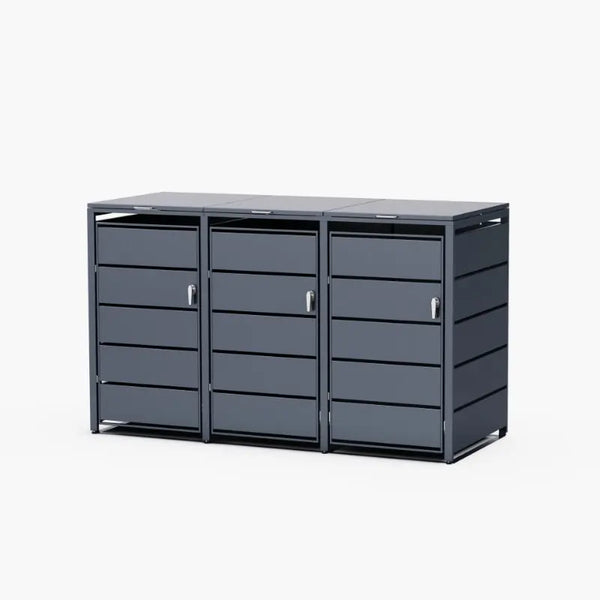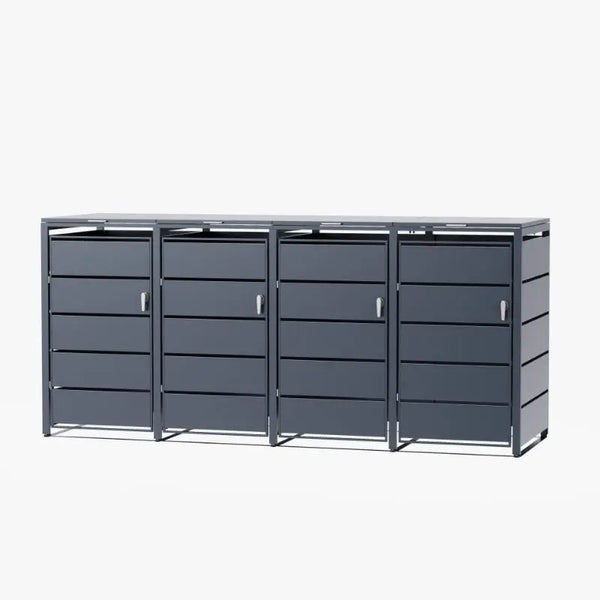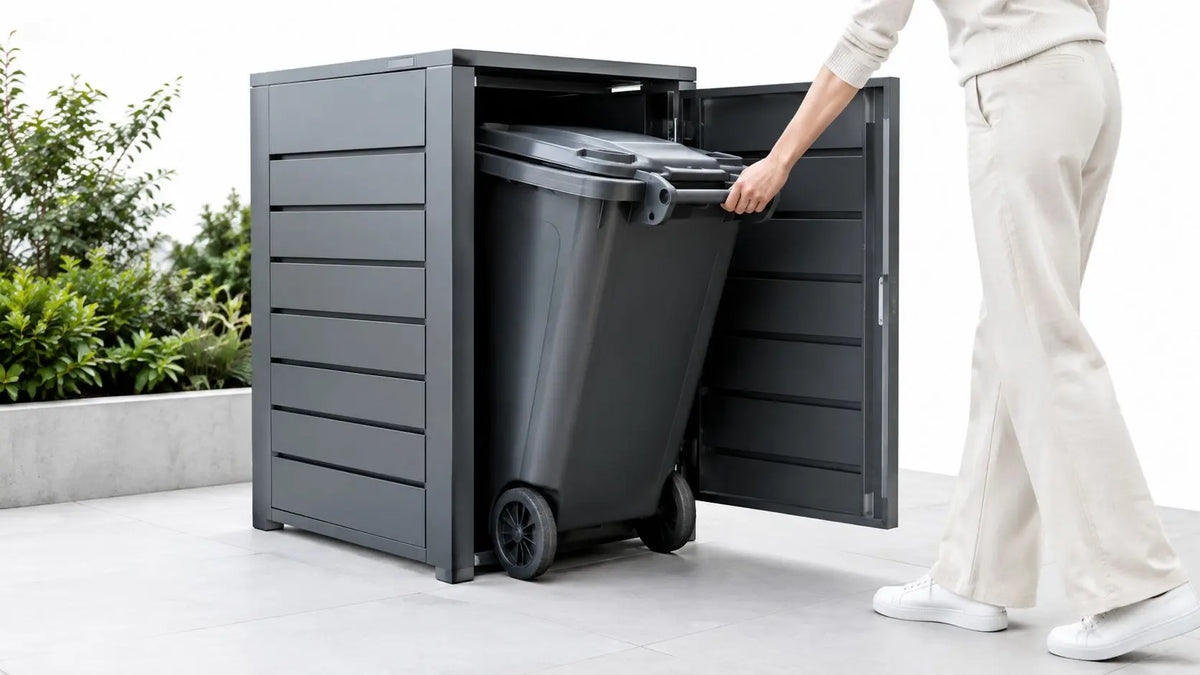
A full 240 L bin stuck behind a narrow hatch is the classic failure. The priority isn’t the exterior finish, it’s the removal maneuver.
The right bin cover makes opening, gripping and returning the bin easy without forcing. The value of an exterior cladding is therefore measured by its ability to remain discreet without creating friction.
Favor handling over pure aesthetics
In the morning, the problem always appears in the same place, when the bin is loaded and the façade, however neat, becomes an obstacle. A door that’s too narrow, a lid that snags or a threshold that’s too high turns a mundane gesture into a small repeated struggle. Over time, it’s not the wood, the metal or the colour that decide comfort, it’s how easily the bin comes out and goes back in place.
The real criterion is the daily gesture
A useful bin cover accompanies the bin’s movement, it does not constrain it. Local layout prescriptions generally aim for quick access to the public road or collection point and smooth circulation to take out, move then put back the container. The façade must remain discreet without creating friction.
Practical rule : if the bin requires bypassing, lifting or a forced half-turn, the cover is already too closed.
In a garden or a courtyard, this difference is felt immediately. A well-thought-out cladding supports the memory of the gesture: you open, you pull, you replace. A poorly designed cladding forces you to think at every passage, and that’s often when it quickly becomes unused.
In addition to an access logic, another use can provide a useful comparison point, such as access and maintenance of an outdoor air-conditioner cover, where ergonomics weigh as much as visual outcome. The principle is the same: hide without blocking. (See MPDiscount guide on air-conditioner covers.)
Ergonomic criteria for extracting a wheeled bin
The real test of a bin cover is played out daily, when you have to take the bin out without force or contortions. A model can be discreet on the façade and remain painful to use if the access is too narrow, if slope is poorly managed or if the lid hinders the grip.
Width, depth and functional clearance
Technical benchmarks give a clear base but vary by municipality. As an indication, recommendations sometimes include 1.50 m width for manual movement of containers and 2 m when traction is mechanical, with recommended slopes (e.g. < 4 % for manual, < 10 % for mechanical). The presentation zone can also be limited in distance from the roadway according to local rules. Check your municipality’s regulations before installation.
These figures are used to size the cover as a handling station: measure the overall width, the depth with handle, then the height with lid open. A functional clearance prevents rubbing, especially when the ground is not perfectly flat or a wall reduces the exit angle.
Standard volumes also remind why the façade must remain generous. Two-wheel bins exist notably in 120, 240 and 360 litres, with total heights of about 950 mm, 1 105 mm and 1 230 mm, while four-wheel models often reach 660 litres. A cover that is too low can block the handle, impede the lid or prevent the bin from fully exiting, even if the whole seems well fitted.
The shape of the opening changes everything
A largely opening façade remains more reliable than a narrow hatch. A front opening with double doors or a lift-up panel assisted by stays allows pulling the bin in line and accessing the lid without a parasitic gesture. The good principle is simple: the opening must follow the bin’s path, not the other way around.
In a well-planned project, ergonomics matter as much as the visible finish. A successful cover does not compress the bin, it removes unnecessary gestures and lets the container come out straight, handle accessible and lid free.
Measure your space and select the configuration
Before buying, take measurements in the order the bin actually moves. The useful measurement does not start with the exterior façade, it starts with the container, its handles, its exit radius and the obstacles around. A slightly sloping floor, a step, a nearby wall or a poorly placed gate can be enough to make a model that looks plausible on paper impractical.
Three measurements to note above all
- Actual width of the bin, handles included, because this determines the required clear width.
- Depth with lid open, to check that the cover’s opening does not block access from above.
- Available height up to the upper obstacle, in order to keep comfortable passage when pulling out then putting back the bin.
Another point is as important as dimensions: it is the usage configuration. A single 240 L bin requires less useful width than a multiple set, but you still need to allow for gripping and frontal clearance. For a narrow courtyard, the cover should favor direct access rather than an enclosure closed on three sides.
The right trade-off is between capacity, circulation and frequency of removal. When the passage is short and free, a simple structure may suffice. When several bins coexist, the layout must leave a clear path so as not to turn collection into a contortion session.
For more on sizing, a practical supplement is available in the MPDiscount guide on choosing a bin cover size.
Double door versus single hatch
The choice of opening changes the experience more than the finish. A single hatch takes up less visual space, but it can hinder the passage of a wide bin, especially if handles protrude or if access must be straight. Conversely, a double door distributes the opening and gives more room around the container.
When a double door really helps
The double door becomes interesting as soon as the bin must exit without complicated rotation. It facilitates aligning the container with the exit, which limits rubbing and reduces the risk of pinching hands. It is also more tolerant if the handle is slightly off-center or if the bin is full.
When a single hatch can suffice
A single hatch remains possible if the cover is wide, if the bin lid opens without touching the structure and if the depth leaves a true passage. The issue is not the hatch itself, it’s its usable width relative to the bin’s actual dimensions. If the opening forces the container to pivot, comfort disappears quickly.
| Configuration | Main advantage | Point to watch |
|---|---|---|
| Double door | Wider frontal access, smoother exit | Requires a well-aligned façade and easy-to-handle leaves |
| Single hatch | More discreet visual reading | Can become too narrow for handles and bin exit |
A good guideline is to imagine the movement with a full bin, not an empty one. Weight changes how you open, pull and regain the return axis. That’s where the access system reveals its true quality.
Respect local collection rules
A bin cover does not just hide bins, it must also remain compatible with your municipality’s collection rules. In several municipalities, bins must be presented with the lid closed to allow lifting and limit waste dispersion. Some services also require that handles be oriented toward the roadway to simplify handling.
A product is only valid if it remains compatible with collection
In some municipalities, a room is directly collectible only under conditions: level access, absence of obstacle, opening without a key or code in certain cases, and a maximum distance between the entrance and the roadway to respect. A shelter that is too closed can block use even if it is elegant. Always check local rules before purchase.
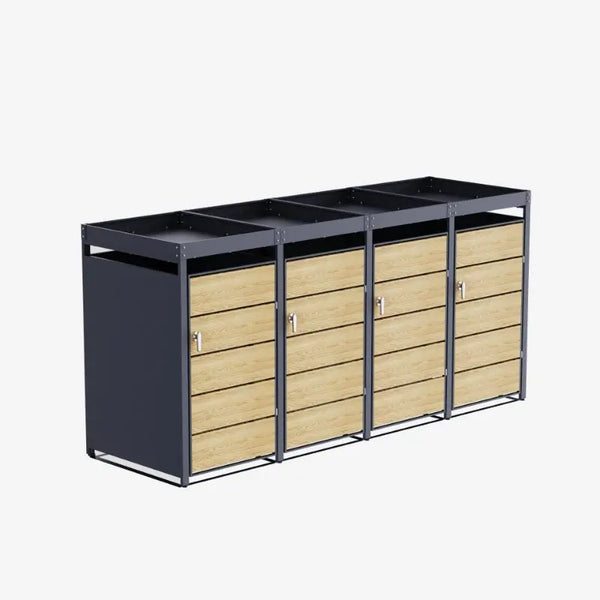
In that spirit, the Abri Cache-Poubelle - 4 x 240L - Structure Métal - Couleur Chêne illustrates a direct access logic, with 4 independent front doors, a lid opening assisted by chain and a powder-coated galvanized steel structure. Its stated dimensions are 260 × 80 × 124 cm, with a capacity indicated up to 4 bins of 240 L. Consult the product sheet to confirm measurements and features before purchase.
If the cover forces you to disassemble, unlock for too long or bypass a barrier, it is already away from its normal use.
The right reflex is to check the local rule before choosing the model. The ideal catalogue cover only has value if it allows the same gesture on collection day, without awkward rehandling or contortion around the bin.
Your pre-purchase checklist
Before confirming a purchase, keep this simple order: access first, opening next, aesthetics last. An attractive but narrow model degrades quickly in use, while a clear and free structure stays comfortable over time.
The most useful is to check these points, in this order :
- Sufficient clear width for the bin and its handles.
- Truly practicable frontal opening, without a bothersome threshold.
- Height compatible with the open lid.
- Simple access to take out and put back the bin without lifting.
- Compatibility with local collection rules, especially for closed lid and handle orientation.
- Stable ground and clear circulation around the cover.
A good cover is recognized by the bin’s return
The decisive moment is not only the exit, it is also the return. If the bin comes back without rubbing, without twisting and without trajectory correction, the cover is well sized. If you have to push it sideways or lift the front slightly, comfort degrades immediately.
To compare configurations and formats, look for example at the 2 x 240 L bin cover and other MPDiscount models. Always check the product sheet corresponding to the reference to confirm dimensions, capacities and opening options.
MPDiscount offers outdoor bin covers designed for daily use, with product sheets to verify according to capacity, opening and layout. To compare formats suited to your space and prepare a more functional purchase, visit MPDiscount and consult the product sheets of the references that interest you.