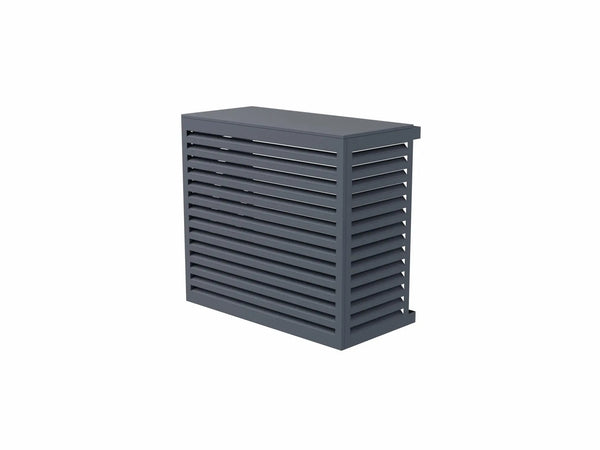
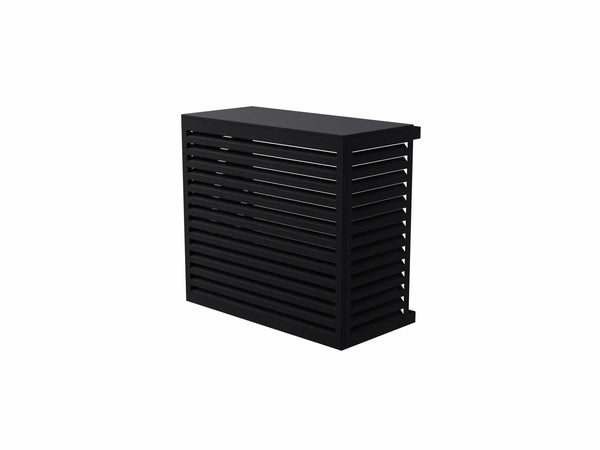
Your outdoor unit is installed on the balcony, the terrace or in a small courtyard, clearly visible from the living room. A cover then seems the obvious solution, until the day the technician must reach the connections, open the hood or clean the exchanger. The outdoor air conditioner cover must therefore provide for access and maintenance from the time of purchase, not after installation.
A cover is not a piece of furniture placed in front of equipment. It is a technical accessory that must respect ventilation, condensate drainage and allow maintenance operations. The regulatory framework may require inspections for circuits containing refrigerant; request the applicable documents for your installation and check the appliance manufacturer’s manual.
Think of the cover as an intervention scenario
A successful enclosure is not judged only when the unit is neat and discreet from the living room. It is also judged when the professional arrives with tools, must inspect the connections, check the fan or access the electrical terminal block. If every operation requires moving a heavy structure, the cover becomes an obstacle.
Before buying, imagine the likely interventions:
- Visual inspection: access to the fan blade, the exchanger, cables and signs of moisture.
- Routine maintenance: removal of leaves, dust and vegetation around the unit.
- Refrigeration maintenance: access to fittings, valves and lines that may be leaking.
- Repair: ability to remove a panel without moving the outdoor unit.
Practical rule: the face located in front of the connections and the hood must remain removable, widely open or quickly detachable.
When the configuration does not allow reaching all risk points, inspection focuses on accessible points and must be supplemented by monitoring relevant parameters (checks, measurements or readings). A cover that is too closed can complicate inspection, prolong the intervention and lead to partial removal.
The collections of covers for air conditioning and heat pumps on MPDiscount can serve as a starting point, but compatibility must always be checked against the appliance dimensions and the manual. The project must combine aesthetics, airflow and technical access. The first step is to record measurements on site.
Take the useful measurements before choosing any cover
Before looking for a finish, take measurements as a site technician would. Overall dimensions of the unit are not enough: note anything that could hinder opening a panel or using an instrument.
On-site measurement form to fill in
Note the following elements:
- Overall width, depth and height, including feet, supports and any protections.
- Position of the refrigerant connections (side, rear, underneath).
- Location of the electrical terminal block, the power control and the cables.
- Position of the fan and the discharge grille, to avoid a wall too close to the air outlet.
- Condensate drainage, direction of the pipe and space required around it.
- Actual access in front of the unit, enough for a professional to stand facing the unit with a toolbox.
Then draw the reserved volume, that is the free volume in which the cover will be installed: lateral, rear and front clearances, and the working area needed to remove the hood or reach the connections.
Good practice guides indicate common clearances; some manufacturers require larger values depending on the model. These values appear in the manufacturer’s technical documents and do not replace them.
A perforated façade does not correct a reserved volume that is too narrow. If the cover is placed too close to the air discharge, it can increase pressure loss, promote recirculation of hot air and degrade performance. To organize measurements, consult the MPDiscount product sheet corresponding to the chosen reference; the appliance dimensions remain the priority.
Distinguish visual camouflage, sound comfort and sound insulation
An outdoor cover is primarily a visual cladding. It does not automatically become an acoustic device simply because it has slats, a solid panel or a decorative finish.
Three notions are often confused: camouflage (reduction of visibility), acoustic correction (reduction of reverberation inside a space) and sound insulation (limitation of noise transmission). Absorption reduces reflections inside a space; insulation limits transmission of sound through a partition.
What a cover can actually change
A perforated cladding can change the visual perception of the unit and, depending on its geometry and location, influence certain reflections on a courtyard or façade. No decibel reduction should be claimed without measurement performed on the exact installation.
A structure that is too closed can block the air outlet, create turbulence or reflect more noise toward a nearby window. Sound levels quoted by manufacturers are indicative and do not predict the noise level of a particular installation without measurement.
Simple, comparable checks:
- listen to the unit turned on then off at the same location;
- observe vibrations transmitted to the fixings;
- check that grilles are not obstructed;
- request a professional measurement if neighbors dispute the noise.
The Public Health Code retains a general rule for neighborhood noise, based on duration, repetition or intensity. A cover does not replace correct placement, stable fixings or regular maintenance.
To deepen the distinction between absorption and insulation, consult MPDiscount guides on acoustic panels; remember that an absorbing decorative panel is not a complete treatment against external nuisances.
Three families of outdoor cladding to compare
The choice is not between “pretty” and “technical”, but between fixing method, access and resistance suited to the location. Three families frequently recur:
- Decorative acoustic panel: fixed by bonding, adhesive or other according to the product sheet; limited access if permanently installed; outdoor use should be retained only if the product sheet confirms it (resistance to humidity, UV, etc.).
- Rigid PVC panel: screwing onto a frame recommended; good access if panels are removable; easy cleaning; check the product sheet for outdoor use.
- Perforated cladding for outdoor unit: screwing or assembly on structure; access facilitated by openings or removable panels; the most coherent family when ventilation and intervention are priorities.
Decorative acoustic panels
Soft or decorative acoustic panels are designed for indoor use. They should not be repurposed for a balcony or exposed façade if the product sheet does not validate that use (humidity, UV, heat are risks of alteration).
The dimensions and thicknesses indicated in some product sheets (for example 240 × 60 cm, 11 mm, packs of 4; or 21 mm for other references) concern only the corresponding references and should not be automatically transposed to an outdoor cover.
Rigid PVC and perforated cladding
Rigid PVC offers an easily wiped surface and can be suitable for a façade screwed to a frame. Provide a stable frame and a removable façade. A solid panel in front of the discharge remains a poor choice, even if it is aesthetic.
Perforated cladding is generally more logical for a unit installed outdoors. Its openings must preserve airflow and allow technical access. For each family, the product sheet must specify the installation method and conditions of use; check these elements on the MPDiscount product page.
Choose the installation according to the product and the configuration
Installation determines the ease of maintenance. A cover screwed onto a frame can be opened panel by panel. Bonding requires a compatible substrate and attention to residues in case of removal. A self-adhesive flexible panel has no place outdoors if the product sheet does not confirm outdoor use.
Common options
Screwing onto a frame facilitates reversible interventions. Bonding requires a compatible substrate and attention to residues in case of removal. Whatever the choice, the central question remains: which face opens, how does it open and where does the professional stand?
MPDiscount offers decorative panels, rigid PVC panels and outdoor cladding solutions. Among the offered references is, for example, an aluminum cover for air conditioner/heat pump. Check the product sheet of the chosen reference for dimensions, installation method and conditions of use.
Professional access and maintenance (general instructions)
Before any intervention, consult the appliance manufacturer’s manual and, if necessary, call a qualified professional to learn the safety and intervention instructions applicable to your installation. Recommendations vary by model and regulation.
Routine maintenance — frequently checked points: remove leaves and vegetation around the cover, visually inspect the exchanger, condensate tray, ventilation and cable condition. Prefer gentle means for fin cleaning (soft brush, controlled air) and avoid high-pressure jets or aggressive solvents directed at electrical components. Condensate drainage must remain clear; it can be cleaned with water or solutions appropriate to the manufacturer’s recommendations.
For equipment containing significant quantities of refrigerant, regulatory inspections may apply. Consult the regulations and a professional for the applicable procedures and frequencies for your installation.
Final checklist before ordering
Before ordering, verify that the technician will be able to work on the unit without removing the entire structure. This validation includes:
- Recorded measurements: overall dimensions, connections, terminal block, fan and condensate drainage.
- Accessible face: removable panel in front of connections and the hood.
- Checked clearances: refer to the appliance manual and the manufacturer’s technical documents.
- Compatible installation: fixing method suited to the product and the support (screwing, bonding, etc.), check the product sheet on MPDiscount.
- Ventilation preserved: no obstacle in front of the discharge nor return of hot air.
- Maintenance planned: cleaning around the cover and access reserved for the professional.
- Product sheet checked: dimensions, installation method and conditions of use on the MPDiscount product page of the chosen reference.
Consult MPDiscount collections and products dedicated to outdoor claddings and installation accessories according to your actual configuration. A relevant cover remains openable several years after installation if its installation method and access have been correctly chosen.
To move forward, consult MPDiscount offers (e.g. aluminum cover for air conditioner/heat pump) then check on each product sheet the dimensions, installation method and conditions before ordering.